
I read an article the other day (and lost the address) the explained that it might be possible to resuscitate people quite a long time after their heart has stopped beating. Despite expectations, cells seem to be able to survive relatively long periods without oxygen. The cells just have to be brought back into the world of oxygen slowly, or they freak out and die. From my not-a-cardiologists viewpoint this is a big step forward in our understanding of how to revive those who have had heart attacks.
Since this discovery allows us to resuscitate people who previously would have been considered dead it brings up the question “what is death?”. I’m not talking about what happens after death or death’s meaning. Instead I’m simply asking when can we consider a person impossible to revive or “dead.”
There appears to be an easy answer to this question. It would go something like “death is when one falls out of consciousness for the last time.” I will call this the pragmatic definition of death. After this point one can no longer communicate with the person. This is also the moment when a person stops experiencing their life. Yet, in order to define ‘last time’ one must depend on many other things, including the state of medical knowledge. For example when a person lost consciousness from a heart attack in 1205 AD, they were pragmatically dead. However, when one looses consciousness after a heart attack in 2007 it is quite possible that this is not the ‘last time.’
But, when can we declare for sure that someone has lost consciousness for the last time? A point when it has been so long since one fell unconscious that it is logically impossible to resuscitate them? To consider this question we will need some sort of definition of the mind/identity. The two most prominent such definitions are either that a person is a soul or they are a pattern (like a pattern of neural firings).
With either the soul or pattern view one could argue it is impossible to ever be sure that consciousness has be lost for the last time.
First let’s assume that people are souls. Souls are by definition indestructible. Thus annihilation is impossible and resuscitation can never be completely ruled out.
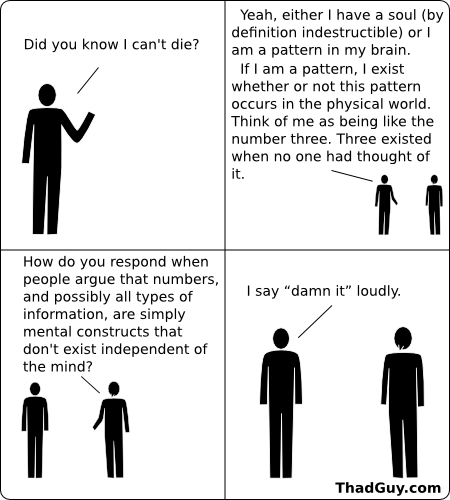
Now, to consider the possibly that people are patterns we need to take a less direct line of reasoning, that begins with numbers. Many consider the number 3 to exist independent of either our ability to understand it or its occurrence in the world (Mathematical Realism). We have discovered the number 3, but not created it. Even if we all forgot the number 3, it would continue to exist. Our forgetfulness can not annihilate it. In this sense the number 3 is eternal. This view applies to other numbers. For example, 523365487 is also eternal. In fact this view could be applied to almost all information…like patterns in a brain…. Thus, even patterns are impossible to annihilate and resuscitation can never be completely ruled out.
Maybe there is no point at which resuscitation is impossible. Perhaps death is never certain.
[One funny implication of this view is that every bit of information, every person/intelligence, that is possible, ‘exists.’]
Comments (12)
I will grant you that pragmatically this might be impossible. Nevertheless it can be interesting to talk about.
Thank you for the correction.
I think a person is dead when any and all brain activity has stopped.
However, it seems possible for even the positions of trillions of complex cells to be represented as information. In this sense our brain, and even the rest of our body, could be a "pattern."
As the brain cells develop and then deteriorate and die, the way a human sense's, records, recalls and deals with reality changes.
The way a 1 year old relates to the world is very different to the way a 5 year old relates to the world which is very different from the way a teenager relates to the world which is very different from the way a 30 year old relates to the world which is very different to the way a senile octogenarian relates to the world.
Brain cells continue to be added from the first few months after conception to the end of the first half year of life outside the womb. These cells mature at different rates, depending on where they are in the brain. The brain is fully mature at around the age of 19 when it performs at its peak.
Brain cells begin to die from early childhood. Any part of memory or function which is stored in dead cell is permanently lost. Since there is a lot of redundancy, the loss of a skill or the distortion of a memory is generally not obvious unless there has been a dramatic and sudden loss of brain function.
The person who has had a stroke has already partly "died". They are like an amputee whose existance continues minus a limb. Only part of their body/brain continues to exist.
If a person's consciousness was to be "resurrected" then which one would it be? Would it be the one they had at the age of 1? 5? 10? 30? 60? senility? pre-stroke? post-stroke? Which memories would they recall? What about false and distorted memories?
What consciousness would a boxer have after "resurrection"? Would it be the one he had just before he lost his first brain cell to boxing? Would it be the immature one he had before he lost his very first brain cell during childhood?
Of course, the same questions would apply to the type of "spiritual body" a human would have after "resurrection". Do they have the physique that had at the moment of brain death. Which parts removed by accident or surgery to they have in the "after life"? Do they have parts which were damaged at some time before physical death? Are they resurrected with all their genetic flaws?
The personality and cognitive "footprint" of a person is strongly dependent on the stage of life, their experiences, what they recall of past events, what they have learned ... and so on.
Which aspects of a person would survive or be restored in this hypothetical situation? To whom would they be recognizable following this restoration? Would they be recognizable as the "same" person at all?